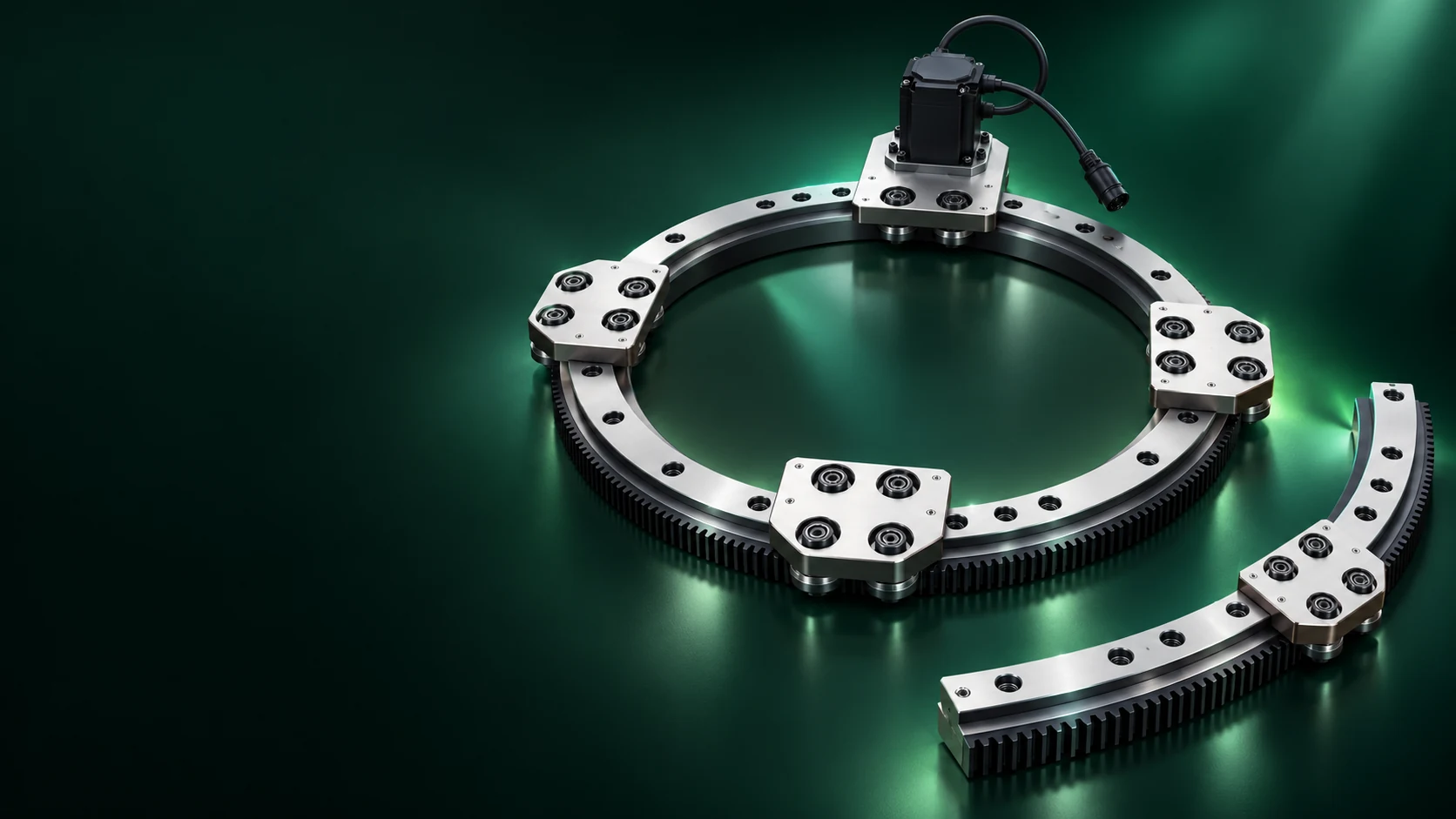
The SANJ website presents six curved-guide families from the supplied product catalogue. Their dimensions support initial selection, but a family name does not establish a complete system rating. Read the dimensional table and drawing together before choosing a model.
The six published guide families
| Family | Profile width | Listed D range | Arc rows |
|---|---|---|---|
| T25GR | 25 mm | 200–1000 mm | 11 |
| T23-24 | 23 mm | 200–600 mm | 8 |
| GV25C | 25 mm | 200–400 mm | 5 |
| GV44C | 44 mm | 468–612 mm | 2 |
| GV50C | 50 mm | 468–800 mm | 3 |
| GV76C | 76 mm | 1000–1501 mm | 4 |
These are published catalogue choices, not a statement that every intermediate diameter is a standard model. Non-standard geometry needs a separate drawing review.
D is a drawing reference, not a guess
The model suffix corresponds to the D value in the catalogue table. Where B and A are also supplied, they identify different diameters on the drawing. For example, T25GR-200 lists B 175, D 200 and A 225. Treating the suffix as the outside diameter would therefore give the wrong envelope.
GV50C and GV76C tables do not publish the same B and A columns. Do not fill those missing fields by borrowing a calculation from another family.
Arc coverage is separate from diameter
The catalogue shows 90°, 180° and 360° arc options. State the required coverage as well as the diameter. A partial arc and a full ring with the same D are different components, and a segmented circulation track also needs its straight lengths and joint interfaces specified.
Keep the source symbols visible
The tables retain h, H, X, Y, Z and n*H so they can be compared with the source drawings. Some X and Y cells are blank, and not every symbol has an explicit unit definition. A dash on the website means unspecified in the source, not zero. Obtain a clarified project drawing before production.
The GV25C straight-guide page has a source-label discrepancy: the heading identifies GV25C while the source table repeats a T25GR label. The website notes this issue instead of silently presenting the designation as resolved.
Review the matching straight carriage
The corresponding straight-guide drawings provide carriage dimensions A through G, pitch P, overall rail length L and mounting references. They list L as 4 m. S is described as an end distance without a numerical value. An installed length, support arrangement and joint plan still need confirmation for a custom loop.
Turn a dimensional choice into a project selection
After checking the envelope, review total moving load, fixture moments, acceleration, station forces and required positioning. Compare the T25GR, GV44C and other rail series with your machine requirements. Use the downloadable dimension table as a reference and submit the intended configuration for review.
Common questions
Can two families be substituted because they share a diameter?
No. Check the profile, carriage geometry, holes, working height and mating components. Matching D does not establish interchangeability.
Does the widest rail automatically provide the right load capacity?
No. The full assembly and operating loads determine the selection. The source dimensional tables are not load-capacity tables.