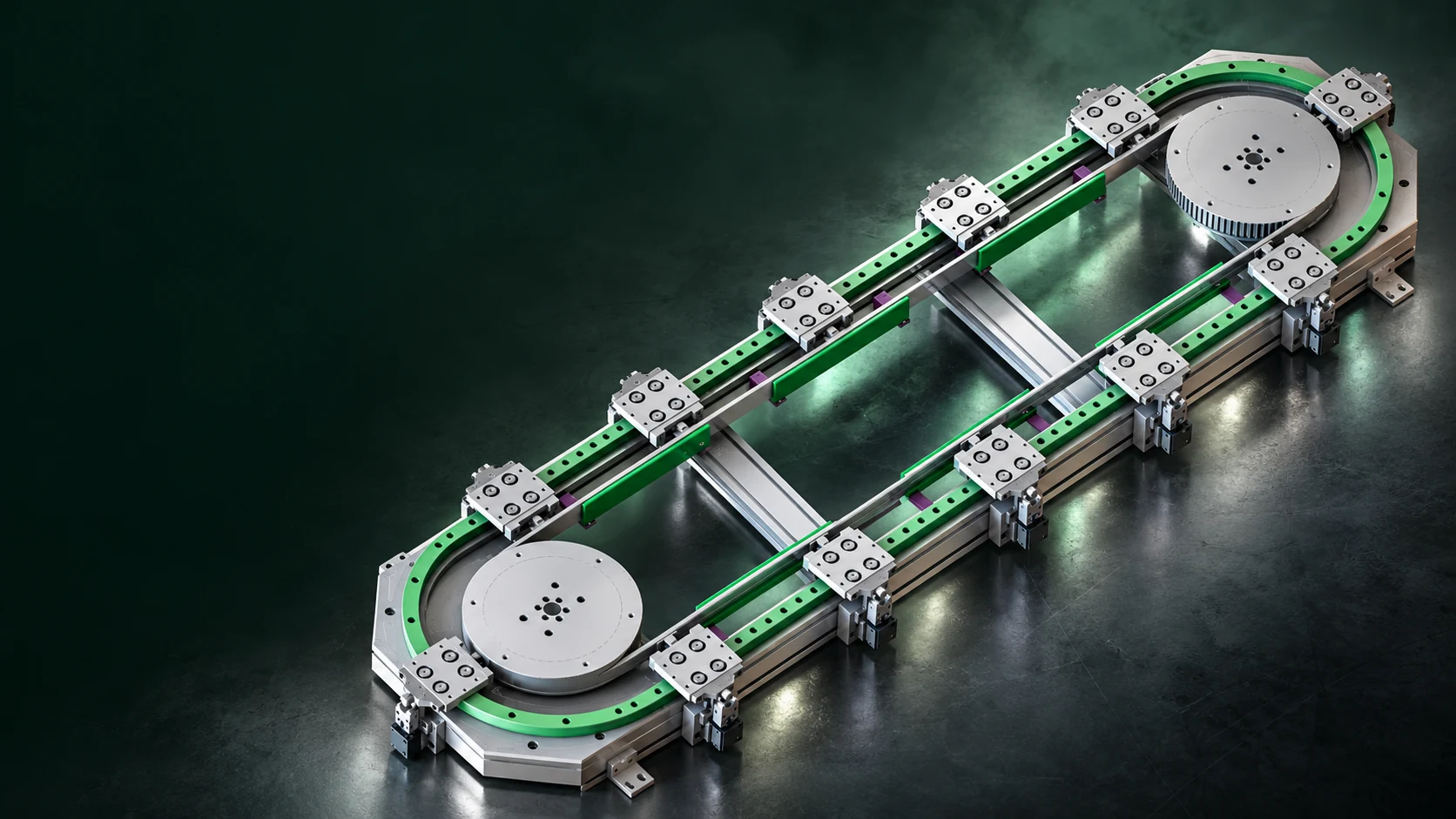
A custom ring guide is selected around a machine process, not a diameter in isolation. A rail can fit the available footprint yet leave too little clearance for a fixture, put a return curve in the wrong place or leave the drive and station-positioning interfaces undefined.
1. Start with the station plan
Draw the available equipment envelope and mark loading, assembly, inspection and unloading positions. Include operator access, robot reach, guarding and maintenance space. An oval track offers two long straight sections; a rectangular layout can place stations around more sides of the cell. A vertical layout changes how fixtures and workpieces must be retained through the return.
Use the fixture envelope, not only the part outline, when checking a curve. An overhanging tool or cable connection can sweep into the adjacent carriage even when the nominal pitch appears sufficient.
2. Describe every load that matters
Record workpiece mass, fixture mass and centre of gravity. Then describe external forces applied at work stations. Pressing, fastening and testing loads can differ substantially from the weight carried during travel. Include any moment created by an offset fixture. The rail, rollers, carriage plate and support frame need to be reviewed as a system.
Do not assign the general load statement in a brochure to every catalogue rail. The proposed configuration needs its own operating requirement and engineering review.
3. Separate move time from working time
A cycle contains movement, settling and the process itself. State the required station-to-station time and how much of it is available for travel. Include planned acceleration, the number of carriages and whether they move together. If these are undecided, provide the production sequence and the target output rather than choosing an arbitrary maximum speed.
4. Define where position is measured
Travel accuracy, repeatability after a stop and repeatability after a locating mechanism engages are different requirements. Name the measuring point on the fixture and the datum on the machine. State the load and process condition during measurement. Read our positioning specification guide before putting a single accuracy number into an enquiry.
5. Agree the supply boundary
A rail quotation and a complete conveyor quotation cover different work. Specify the need for carriages, fixture plates, frame, drive, gearbox interfaces, lubrication, sensors and station mechanisms. Identify who provides the controller and guarding. The approved drawing and quotation should describe these boundaries.
What should you send SANJ?
Send a layout or sketch, payload and fixture drawing, station count and pitch, process forces, move and dwell times, positioning requirement, environment, quantity and target schedule. Include the required drawing revision when replacing an existing component. A complete brief helps resolve the important choices before manufacture.
Download the editable project checklist, compare the catalogue guide families, or submit a custom project enquiry.
Common questions
Can a standard rail series be used in a custom assembly?
Yes. Catalogue geometry provides a starting point, while the installed layout, interfaces and operating requirements are reviewed for the assembly.
Is a footprint enough for a quotation?
It is useful for an initial discussion. Payload, fixture clearance, cycle, process loads and supply scope are also needed for a meaningful configuration.